


In January 2024, a DPD customer was searching for their customer-service number. He stumbled on to the AI bot on DPD’s website which refused to share the number. When frustrated after a few minutes, the customer got the bot to swear, write a poem about how useless it was and call DPD "the worst delivery firm in the world". The BBC, Reuters and the Guardian covered it. DPD disabled the AI bot after it blamed an error after a system update.
Many such stories exist in the wild. For good reason, AI chatbot vs human customer service is a polarizing topic. But one thing is clear - just because an AI bot can answer customer questions, does not mean human agents need not participate in the support activities.
AI chatbot vs human customer service: what each is actually good at
So, should you leave everything to an AI chatbot or just get rid of it fully? We are sorry to disappoint you. But the answer is - it depends. Context drives this decision, not some fixed rule.
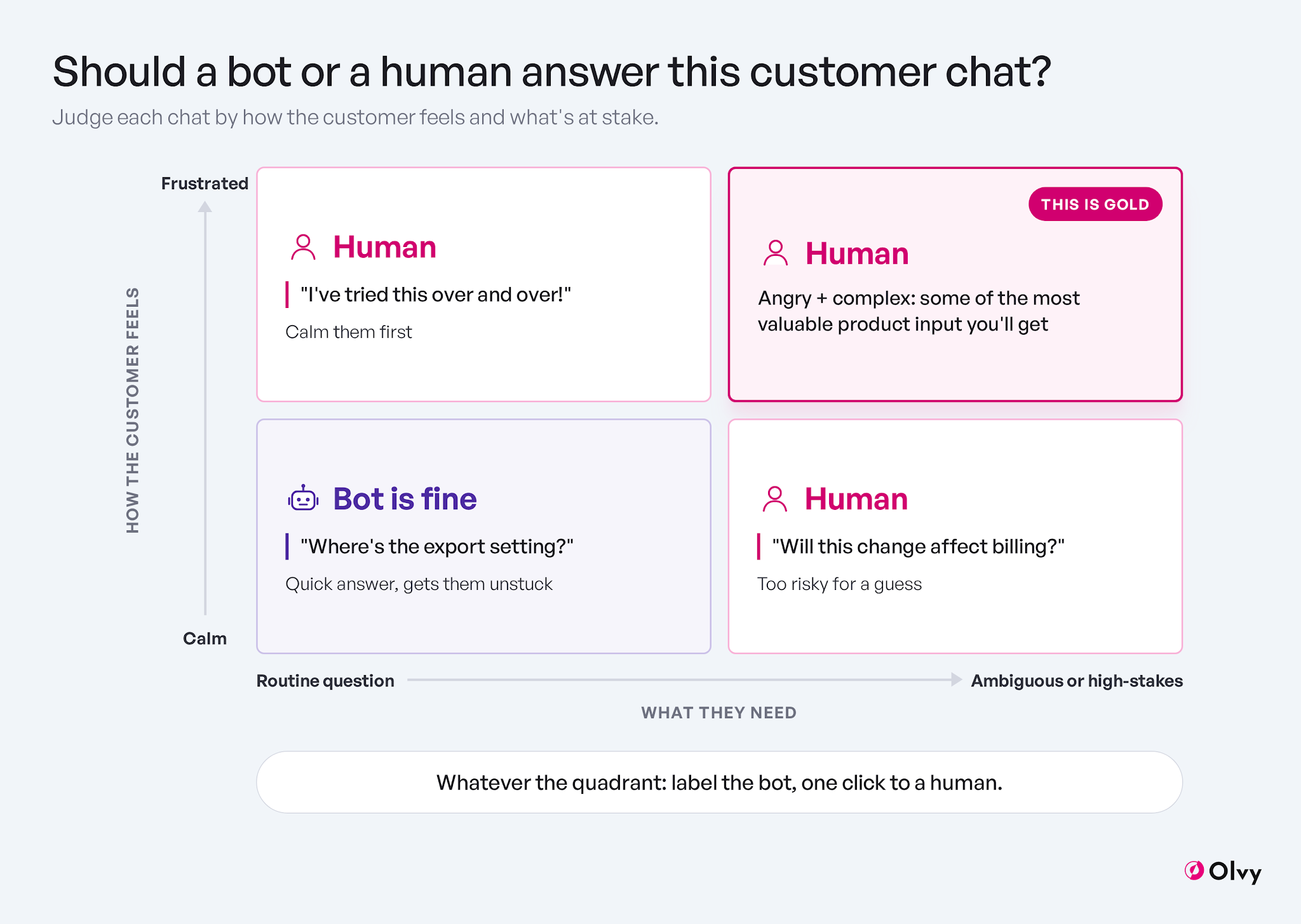
Hand it over to a bot when the customer on the other end of the chat needs a fast, correct answer to get going: "Where's the export setting?" at 11pm. Underline the "Correct" word here. Remember - A fast but wrong answer does more harm than a slow but right answer.
Pass it on to a human if the customer on the other end of the chat is angry/excited, has shared ambiguous info, high stakes and anything that needs judgment or an exception. Bots can't read the mood or make exceptions.
“Should an AI bot or a human answer this chat?” - we think about this question as a matrix with 4 quadrants:
- Urgency: does the customer need an answer quickly to keep working?
- Emotion: is the customer calm or frustrated?
- Stakes: what’s at stake here? could a wrong answer cost money, data or trust?
- Coverage: is the answer in your docs? Is this part of the existing knowledge?
Calm, routine and documented conversations can be shouldered by the AI bot. For everything else, entrust a human. Angry conversations are some of the most valuable product input you'll get, so route them to your Product Managers and document what they tell you.
Objection 1: AI can handle support, so why pay for humans?
Let us clear the central myth of this argument - AI bot is not where the risk lies. It lies with the AI bot that does not offer a way to connect to humans.
In a Gartner survey of 3,566 customers published on 2 September 2026, 87% said access to a human agent is essential when companies use GenAI in customer service. Only 27% would try a chatbot again after a negative experience.
The US Consumer Financial Protection Bureau warned about this in 2023, calling them "doom loops": repetitive, unhelpful answers with no offramp to a human.
And the AI bot represents your brand, so what it says has implications. For example - In February 2024 British Columbia's Civil Resolution Tribunal held Air Canada liable after its chatbot wrongly said a bereavement fare could be claimed retroactively.
Here’s how to ensure that your in-product AI bot does not piss off your customers.
Design the switch: four rules for transparency and handoff for in-app AI chats
- Be transparent. Don’t try to make it sound like a human. Say it's a bot from the first message. You can even open with "I'm an AI assistant. I can answer setup questions or get you a human."
- Make talking to a human no-brainer. The customer should not have to guess the keyword to connect to a human..
- Give the human the full bot conversation. The customer should never have to repeat themselves.
- Be honest about when a human will reply. If no human agent is available, say when someone will be. Set the right expectations.
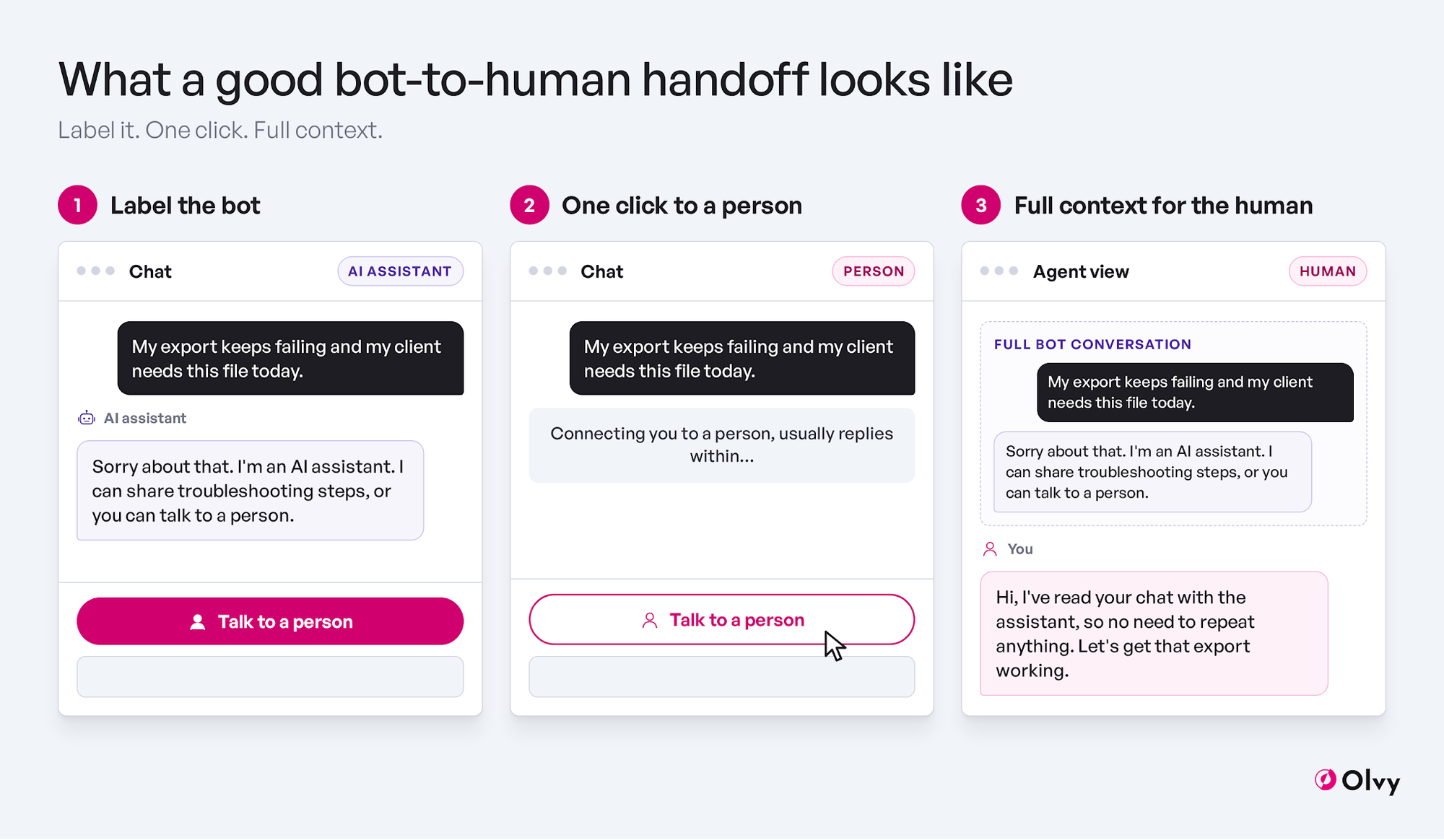
Products that get this in-app messenger AI bot to human hand-off right, give another reason to customers to choose that product.
Who answers? Put the whole team on the rota
Start small, there is no need for a full-fledged support department. Founders, Product Managers and frontline engineers can own the in-app messenger chats on rotation. Ensure that they reply as soon as possible, and when it's not possible, set the messenger’s messaging to set the right expectations. Always remember - Customers prefer an upfront tomorrow morning than a vague soon.
Humans helping humans, with AI in their corner
At Olvy, we are rooting for humans that have the AI assistance on their side. Olvy Messenger is a human-staffed in-app chat: users send screenshots/screen recordings right from within your product. And your team replies from inside Olvy. Olvy AI recommends actions to whoever is answering, based on the 360-degree profile Olvy builds of each customer over time. Actions could be requesting a response on the recent survey, or asking a happy long-time customer for a review, or offering extra help when usage is low.
There's a free plan, so sign up and chat with our humans right from within Olvy 🙂
FAQs
Do you have to tell customers they're talking to a bot?
Some regions across the world make it mandatory by law to do so. For example, in the EU AI Act Article 50 is applicable from 2 August 2026. On the similar lines, California's SB 1001 bans bots that mislead people about being bots to drive a sale.
Is an AI chatbot better than human customer service?
It’s a wrong question. The answer is never either/or, you need both. For fast, routine, documented questions, AI chatbot could be better. But for anything angry, ambiguous or high-stakes (i.e. human), a human is better.
How should a chatbot hand off to a human?
Be transparent from the outset. Call out when a customer is conversing with an AI bot. Make ‘Talk to a person’ one click away in the in-app messenger. The handoff to humans should be the full conversation, and with the timelines expectations set for the customers.
