


Net Promoter Score (NPS) is one of the most widely used methods to measure customer loyalty and satisfaction. But while most teams focus on what to ask in an NPS survey, far fewer pay attention to when to trigger the NPS survey - and that’s where things often go wrong.
Sending an NPS survey at the wrong time can lead to misleading scores, low response rates, or feedback that lacks real context.
For example, asking a new user for feedback too early may not reflect their actual experience, while asking too late may miss critical insights.
The reality is simple: timing directly impacts the quality and usefulness of your NPS data.
In this guide, you’ll learn exactly when to send NPS surveys, how to align them with your product’s lifecycle, and how to ensure the feedback you collect is both accurate and actionable.
Quick Answer: When Should You Send NPS Surveys?
The best time to send an NPS survey is when users have experienced enough value from your product to form a clear opinion about it.
Here are the most effective times to send NPS surveys:
- After users reach a meaningful value moment
- After consistent usage over time
- At regular intervals (e.g., every 3-6 months)
- Around key lifecycle milestones (e.g., renewal or churn signals)
NPS or Net Promoter Score should reflect a user’s overall experience, not a single interaction. That’s why it’s important to avoid sending it too early or tying it to isolated events.
The Two Types of NPS Timings: Relationship vs Transactional
To understand when to send NPS surveys effectively, it’s important to distinguish between two approaches: relationship NPS and transactional NPS.
Relationship NPS (Recommended for most SaaS products)
This is the most widely used form of NPS
- Measures overall customer sentiment
- Sent at regular intervals (e.g., quarterly)
- Reflects long-term perception
This approach helps answer whether users are becoming more or less satisfied over time.
Transactional NPS (Use with caution)
Transactional NPS is triggered after specific events, but it is often misused.
- Attempts to measure sentiment after a milestone
- Can overlap with CSAT if used incorrectly
- Should only be used after meaningful product-level events
For example, transactional NPS may make sense after completing a major workflow, but not after a support interaction or minor action.
Key Takeaway
NPS works best as a relationship metric, not a reaction metric. If you want feedback on specific interactions, CSAT is more appropriate.
Best Times to Send NPS Surveys
Before going into detail, here’s a quick summary of the most effective timing strategies:
- After users experience a clear value moment
- After consistent usage over time
- At regular intervals
- Around key lifecycle milestones
These are not rigid rules, but patterns that help ensure your feedback reflects meaningful experience.
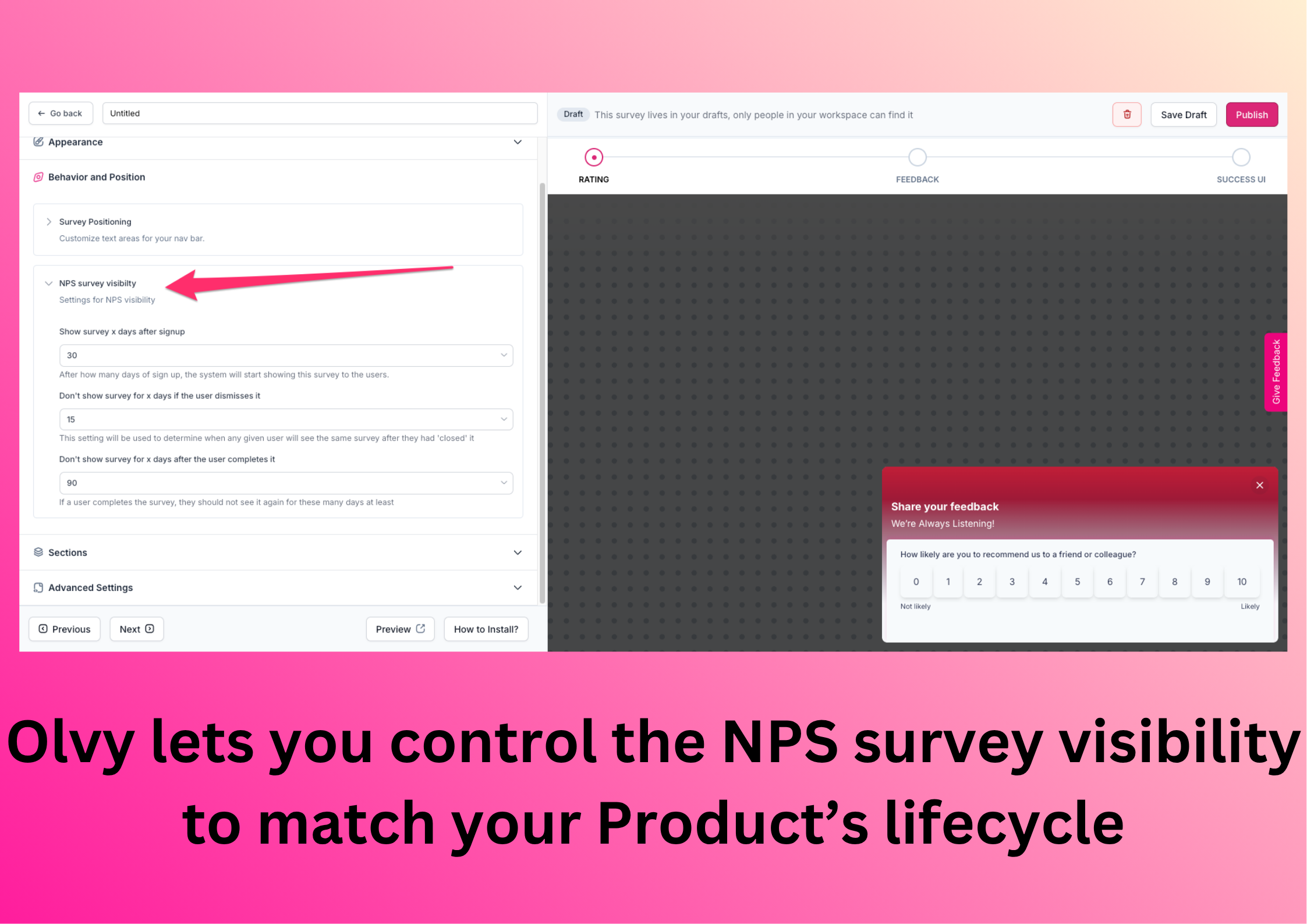
After Users Reach a “Value Moment”
A value moment is when a user successfully achieves something meaningful using your product. This could be completing a core workflow, adopting a key feature, or reaching an important milestone.
At this stage, users have moved beyond initial exploration. Their feedback reflects real experience rather than first impressions, making it far more reliable.
After Sustained Product Usage
Another effective approach is to wait until users have engaged with your product over time. For many SaaS tools, this may mean 30 to 60 days after activation.
This allows users to experience both strengths and limitations, leading to more thoughtful and balanced feedback.
At Regular Intervals
Sending NPS surveys at a regular cadence - typically quarterly - helps track sentiment over time.
This approach enables teams to - identify trends, measure improvements & detect early dissatisfaction. However, NPS surveys should not be sent too frequently, as this can reduce response quality.
Around Key Lifecycle Moments
Important lifecycle moments, such as renewals or signs of declining engagement, are ideal opportunities to gather feedback.
At these points, users are naturally evaluating the value they receive, making their NPS survey responses especially relevant and actionable.
Key Takeaway
The best timing for NPS always follows one principle: experience first, feedback second.
When NOT to Send NPS Surveys
In this section we discuss the most common situations where sending an NPS survey leads to poor results:
- Too Early in the User Journey - If users have not yet experienced real value, their responses will likely be incomplete or uncertain. This leads to inaccurate insights.
- Too Frequently - Over-surveying leads to fatigue. Users may ignore surveys or provide low-quality responses, reducing the usefulness of your data.
- During Unresolved Issues - If users are facing problems, their feedback will reflect frustration rather than overall sentiment. It’s better to collect feedback once the issue is resolved.
- After Minor Interactions - NPS is not meant to measure reactions to small actions. It should reflect the overall experience, not isolated moments.
Sending NPS surveys in the above situations can lead you to invest resources to fix low NPS scores whereas the timing itself was the problem.
How to Choose the Right NPS Timing for Your Product
Unfortunately, as many other things there is no one size fits all. Each product requires its own set of considerations that determine when to send NPS survey. We discuss some common patterns in this regard below.
- Start with the Moment of Value - Every product has a point where users begin to see tangible benefits. This is the ideal moment to trigger NPS.
- Map NPS to the User Journey - Instead of treating NPS as a one-time activity, align it with different stages of the user lifecycle.
- Consider Product Complexity - More complex products require more time before users can provide meaningful feedback. Your NPS survey timing should reflect this.
- Combine Event-Based and Periodic Surveys - Using both approaches gives a more complete understanding of customer sentiment.
Best Practices When Sending NPS Surveys
Getting timing right for sending NPS surveys is only the first step. Then come the best practices around keeping these NPS surveys relatable. Some quick tips below:
- Keep It Simple - A short, focused NPS survey increases completion rates and improves response quality.
- Capture Context - Follow-up questions provide the context needed to interpret responses. For example, if the NPS tool is capable of asking conditional questions based on user submitted score it could be of great help.
- Segment Users - Different users have different experiences. Segmentation helps uncover meaningful insights.
- Avoid Bias - Neutral language ensures honest feedback.
- Respect User Attention - Avoid over-surveying to maintain engagement and trust. Don't make them write a lengthy essay.
Conclusion
Timing plays a critical role in the effectiveness of NPS surveys. Sending them too early, too often, or at the wrong moments can lead to inaccurate feedback.
By aligning surveys with meaningful user experiences, using a thoughtful cadence, and avoiding common pitfalls, you can collect insights that truly reflect customer sentiment.
More importantly, feedback should not stop at collection. When properly analyzed and acted upon, NPS becomes a powerful tool for improving your product and strengthening customer relationships.
